

Ice Age Magic The Gathering Cards
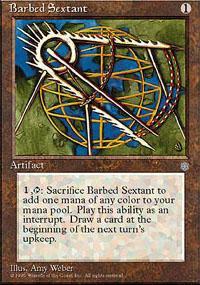
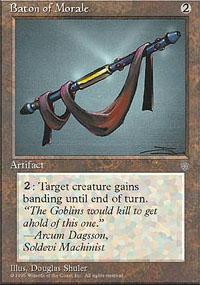
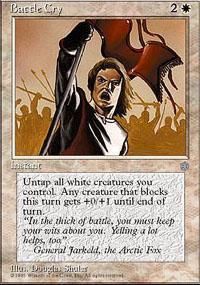
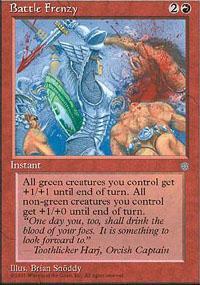
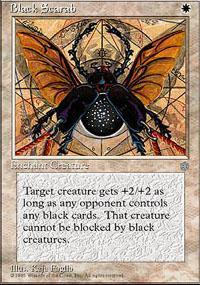
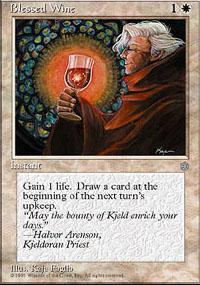
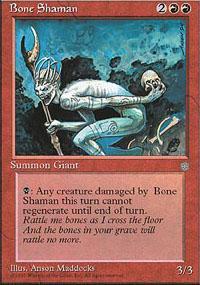
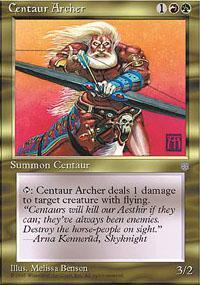
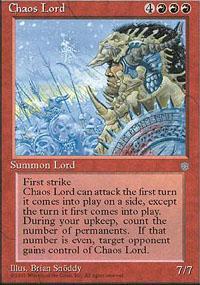
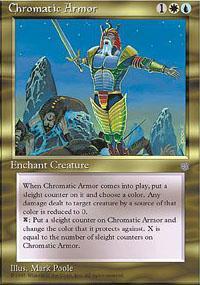
Ice Age was the eleventh Magic: The Gathering set and the sixth expert
level set, released in June 1995. Set in the years from 450 to 2934 AR,
the set describes a world set in perpetual winter due to the events in
Antiquities.
Ice Age was the first "stand-alone" expansion; that is, it was the
first set that could be played independently of other Magic: The
Gathering products. It was the first expansion to reprint the basic
lands (aside from an Arabian Nights misprint that left a Mountain on
the print sheet).
As Ice Age was the first "stand-alone" expansion set, the designers
believed that some "staple" cards from the basic set and expansions
should be in the set. Thus, the set was also the first expansion set
(aside from the Mountain misprint) to reprint cards. Staple cards like
Swords to Plowshares, Giant Growth, Counterspell, and Dark Ritual, as
well as popular older cards like Icy Manipulator were reprinted in Ice
Age. Also, many cards were functional reprints of already-printed
cards; that is, aside from the name (and possibly the creature type),
these cards were identical to cards in other sets. Examples include
Fyndhorn Elves, a functional reprint of Llanowar Elves; Zuran
Spellcaster, a functional reprint of Prodigal Sorcerer; and Order of
the White Shield and Knight of Stromgald, functional reprints of the
"pump knights" from Fallen Empires.
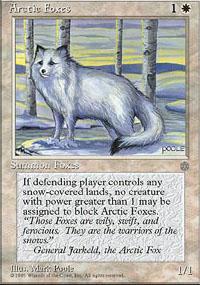
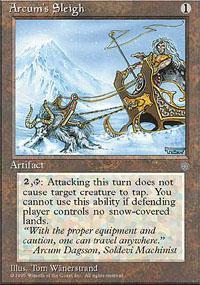
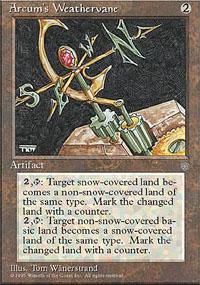
In Ice Age, a new type of basic land was printed: the snow-covered
land. Many players do not realize that, as basic lands, players are
allowed to put as many of them in their deck as they wish (except in
Limited formats like Draft and Sealed Deck). It is possible to build
decks made entirely out of basic lands, such as the five original ones,
or the new snow-covered ones. Some cards had effects that were stronger
when a player used snow-covered lands rather than normal basic lands,
and some effects exposed players using those cards to additional
weaknesses. Currently, snow-covered lands are the only basic lands ever
printed beyond the five normal basic lands. This mechanic was expanded
later in the Coldsnap set, changing the supertype snow-covered to only
Snow, and thus able to appear on nonland cards.
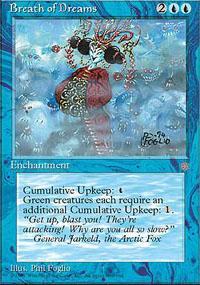
Another new mechanic introduced in Ice Age was Cumulative Upkeep.
This was a way to get better effects for a cheaper price; however, a
player had to keep paying more and more each turn to keep that card in
play. Although cumulative upkeep did not have a large impact on the
game, similar mechanics (such as Urza's Saga's Echo and Nemesis's
Fading) that were born of cumulative upkeep were successful. An
interesting note is that cumulative upkeep uses counters to keep track
of the "upkeep". This meant that the cumulative upkeep mechanic
potentially becomes a source of counters which could be used to feed
cards like "Chisei, Heart of Oceans".
Cantrips were also introduced in Ice Age. This mechanic is based on
effects that had so little effect on gameplay, that they weren't worth
a card. By adding the "draw a card" clause on these cards, players
replaced the card and the effect became more interesting. These
mechanics were later reused in many ways.
Ice Age was also the first set to have legendary permanents of a
single color. In Legends, the first, and until Ice Age, the only set
with Legendary permanents, they were either lands, or were at least two
colors. For the sake of argument Enchant Worlds are not considered to
be legendary in this case even though rules forbid more than one in
play at a time. This was due to the designers of Legends wanting these
legendary permanents to be more exotic than regular permanents. By the
time Ice Age was developed, this stance was softened, and the
single-color legends Marton Stromgald and General Jarkeld were printed.














Daily Mtg Wallpaper

Make Your Own Card
A very cool new magic the gathering related website that allows it's visitors to quickly create their own magic the gathering cards. Check out the one that the Moxdiamond Staff created!